
Poker Stats Explained: A Plain-English Glossary for Live Players
VPIP, PFR, 3-Bet, Agg%, WTSD and the rest, each in a line or two with a $2/$5 example, grouped the way you'd actually use them.
Short answer: almost every poker stat is a simple fraction: how many times a player did something, out of how many times they had the chance to. VPIP is how often they play a hand, PFR how often they raise preflop, Agg% how often they bet or raise after the flop, WTSD how often they reach showdown. Below is every common one in a line or two, with a $2/$5 example, grouped by when in the hand it happens.
If you only want the handful that matter most at a live table, start with the live poker stats worth watching.
How do you read any poker stat?
Look at two numbers, not one: the times the player did it (hits) and the times they could have (chances, or opportunities). “VPIP 40%” is half a sentence. “VPIP 40%, 4 of 10” and “VPIP 40%, 40 of 100” are whole ones, and they mean very different things.
At 4 of 10, one more hand played makes it 45% and one more fold makes it 36%. At 40 of 100, one hand barely moves it. That’s the whole idea behind live poker stats sample size.
Live, the count only includes what you saw and wrote down. If you were at the cage when seat 3 acted preflop, that hand shouldn’t count for or against him.
Sample stats: how much have you actually seen?
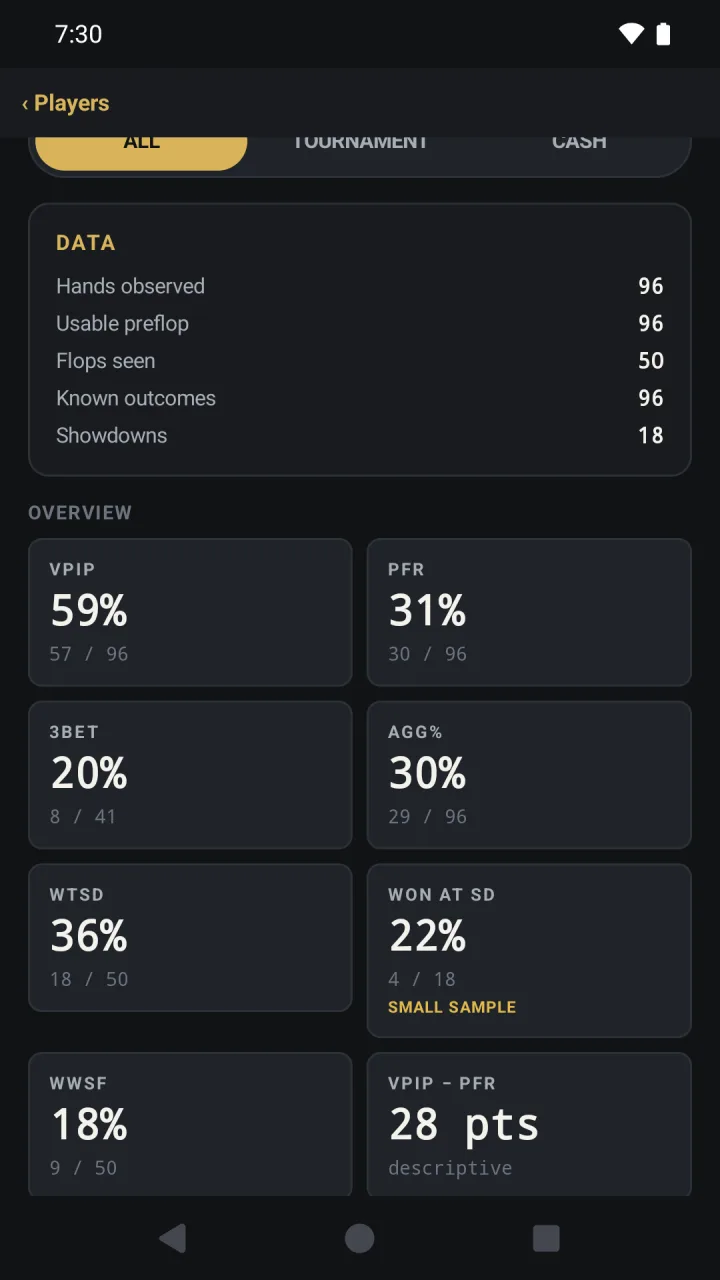
Hands observed. Every hand you recorded with this player dealt in. It’s the headline count, but it’s not the count behind each stat. Example: you’ve logged 96 hands with the $2/$5 reg in seat 4 over three Fridays.
Opportunities (chances). How many times the player faced the decision a particular stat is about. Every stat has its own. Example: of those 96 hands, he faced an open he could 3-bet only 41 times.
Usable preflop hands. Hands where you saw enough of the player’s preflop action to know whether he played and whether he raised. Example: he limped, you looked away, and you’re not sure if he called a raise. VPIP counts; PFR may not.
Flops seen. Hands where the player saw the flop and you saw enough of what happened next. This is the starting count for WTSD and WWSF.
Showdowns. Hands where the player showed cards at the end and you know who won. Usually the smallest count you have.
Preflop stats: how do they get into pots?
VPIP (voluntarily put money in pot). How often a player chooses to put chips in preflop: a limp, call or raise. Blinds, antes, a mandatory straddle and checking the big blind don’t count. Example: 22 of 40 hands is 55%; he’s in a lot of pots. Deep dive: VPIP in live poker.
PFR (preflop raise). How often a player raises preflop: an open, 3-bet, 4-bet or all-in raise. Always at or below VPIP. Example: VPIP 30% and PFR 25% means he raises most hands he plays.
VPIP and PFR gap. VPIP minus PFR, in points. A big gap means lots of limping and calling; a small one means he mostly comes in raising. Example: 45% VPIP and 8% PFR is a 37-point gap: a limper-caller. Deep dive: PFR vs VPIP.
RFI (raise first in). When nobody has entered the pot yet, how often the player opens with a raise instead of folding or limping. Most useful split by position. Example: folded to him on the CO 12 times, he raised 7: 7 of 12.
Open limp. In the same unopened spot, how often he just calls the big blind instead of raising. Example: in a game with a $10 straddle, the UTG+1 regular limps for $10 whenever it’s folded to him.
Call open. How often a player who hasn’t put chips in yet just calls the first raise. Example: HJ opens to $20, he flats on the BTN. That’s a hit.
Re-raise stats: who fights back preflop?
3-Bet. How often a player re-raises when someone has already opened in front of them. The chance only comes when there’s an open, so it fills up slowly. Example: CO opens to $20, he makes it $70 on the button. Deep dive: 3-Bet percentage in live poker.
Fold to 3-bet. After raising preflop and facing a 3-bet, how often the player folds. Call 3-bet and 4-bet are the other two answers to the same spot. Example: he opens to $20, gets 3-bet to $75, and gives up 6 times out of 8.
4-Bet. How often a player re-raises a 3-bet. Rare, so the count stays tiny for a long time live. Example: 1 of 3 is not a pattern. It’s one hand.
Squeeze. A 3-bet after one player has opened and at least one other has called. Example: LJ opens to $20, HJ calls, he makes it $110 from the SB.
Postflop stats: what do they do after the flop?
Agg% (aggression frequency). Bets and raises as a share of all postflop bets, raises, calls and checks. Folds are left out. Example: 30% means roughly one action in three after the flop is a bet or raise. Deep dive: poker aggression stats.
AF (aggression factor). Bets plus raises divided by calls. Swings hard on small samples, and with zero calls there’s no sensible number at all. Example: 6 bets and raises over 2 calls is an AF of 3, until next week’s two calls make it 1.5.
C-bet (continuation bet). How often the preflop raiser bets the flop when no one has bet before him. Example: he opened to $20 from the CO, you called on the button, he bets $25 on K-7-2. Deep dive: c-bet in live poker.
Fold to c-bet. Facing a flop c-bet, how often the player folds. Call and raise are the other answers. Example: you c-bet into him 10 times and he folds 7.
Turn and river barrels. After c-betting, how often the player keeps betting on the next street. Example: he c-bets the flop 8 times and bets the turn again 3 of those.
Check-raise. How often a player checks, faces a bet, and raises. Example: checks the flop from the BB, you bet $30, he makes it $100.
Donk bet. A bet into the preflop raiser before the raiser has acted. Example: you raise preflop, he calls from the BB and leads $40 into you on the flop.
Showdown stats: how far do they take hands?
WTSD (went to showdown). Of the hands where the player saw the flop, how often they reached showdown. Example: 18 of 50 is 36%. Deep dive: WTSD and Won at SD.
Won at SD (W$SD). Of the showdowns the player reached, how often they won at least part of the pot. Example: 4 of 18 is 22%: lots of losing showdowns, but 18 showdowns is still a small sample.
WWSF (won when saw flop). Of the hands where the player saw the flop and you know who won, how often they won the pot, showdown or not. Example: 9 of 50 is 18%; he sees flops and rarely takes them down.
Results stats: how is the money going?
Net result. What you won or lost in a session: cash-out minus buy-ins, or prize minus entries in a tournament.
Results per hour. Net result divided by hours played. The usual live measure, because you know how long you sat. Example: +$600 over 6 hours at $2/$5 is $100 an hour, from one night.
BB/100 (big blinds per 100 hands). Result in big blinds per 100 hands. Standard online, harder live, because you rarely know exactly how many hands you were dealt. Example: live, 30 hands an hour means a 6-hour session is only about 180 hands. More in poker stats to track your game.
Is there a good number for each stat?
No universal one. A 35% VPIP is loose nine-handed with no straddle and ordinary six-handed with a straddle every orbit. Tournament stacks at 15 big blinds make everyone look strange. If you want reference points, compare players from the same game, over similar counts, and treat any range you read anywhere as rough.
Where SSS Poker fits
SSS Poker counts stats from the hands you record and shows hits and chances beside each one, never a bare percentage. The free overview has VPIP, PFR, the gap, 3-Bet and Agg%, and the profile also shows WTSD, Won at SD and WWSF. Pro adds full player analytics by position and lets you tap a stat to see the hands behind it; how player stats work explains exactly how each one is counted.