
Continuation Bet Percentage in Live Poker: C-Bet and Fold to C-Bet
C-bet % tells you how often the preflop raiser keeps betting on the flop. Fold to c-bet tells you how often people let them have it. Live, both are worth watching, as long as you count the right spots.
Short answer: continuation bet percentage (c-bet %) is how often the player who raised last before the flop bets the flop when they get the chance. Fold to c-bet is the other side: how often a player folds when someone c-bets into them. Together they tell you who keeps the lead and who gives up, but only if you count the right spots and look at how many there were.
What counts as a c-bet?
A c-bet needs two things. The player was the last one to raise preflop, and on the flop nobody bet before them.
| Spot | C-bet chance? | C-bet? |
|---|---|---|
| CO opens to $15 at $2/$5, BTN calls. CO bets $20 on the flop | Yes | Yes |
| Same hand, CO checks the flop | Yes | No |
| CO opens, BB 3-bets, CO calls. BB bets the flop | Yes, for the BB | Yes, the BB was the last raiser |
| CO opens, BB calls, BB leads the flop | No, someone bet first | No (that’s a donk bet) |
| Five limpers, nobody raised | No, there’s no preflop raiser | No |
| CO opens and is all in preflop | No, nothing left to decide | No |
The bottom number is the chances, not the hands. A player who opens a lot and gets called will have many c-bet chances. One who mostly limps will have almost none.
What’s fold to c-bet?
It counts the hands where a player faced a c-bet on the flop and had a real decision. The hit is folding.
Many trackers show the whole spread instead of one number, which is more useful:
| Facing a flop c-bet | Count | Share |
|---|---|---|
| Fold | 11 | 55% |
| Call | 7 | 35% |
| Raise | 2 | 10% |
| Chances | 20 |
Just arithmetic to show the idea, not data from any player.
A player who folds 55%, calls 35% and raises 10% is a different opponent from one who folds 55% and raises 45%. Fold to c-bet alone hides that.
How do you read c-bet % at the table?
Compare it with the rest of the table, not a chart.
High c-bet %. The guy in seat 4 at your $1/$3 game opens, and bets the flop pretty much every time. That’s a lot of bets with nothing. Against him, a call on the flop with a decent hand, or a raise now and then, can work well. Watch what he does on the turn: a lot of players fire the flop and give up.
Low c-bet %. She opens, and only bets the flop when she hits. When she bets, believe her more. When she checks, the pot is often up for grabs.
Middle numbers. Most live regs land somewhere in between, and the number alone says little. The board and the opponent matter more than the overall rate.
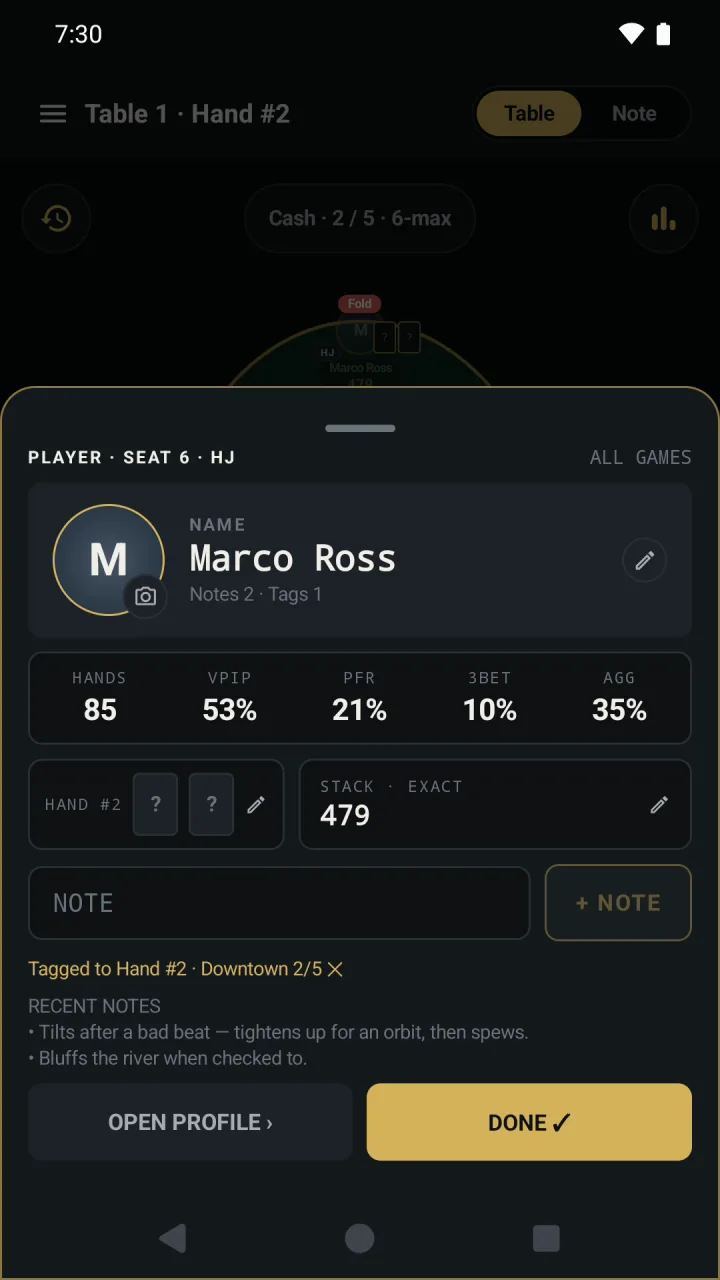
It also helps to put c-bet % next to aggression frequency. A player with a high c-bet % but low aggression overall bets the flop on autopilot and slows down later.
How do you read fold to c-bet?
High fold to c-bet means the player gives up on a lot of flops. Against them, a c-bet in a heads-up pot works often, even with nothing.
Low fold to c-bet means they stick around. Bluffing them on the flop costs you money; betting your good hands three times gets paid.
Look at the raise share too. A player who raises c-bets often is pushing back. Your small, automatic flop bets get attacked.
Why do heads-up and multiway c-bets need separate reads?
Because they’re different decisions. Betting into one player on A-7-2 is easy. Betting into four players at a straddled $2/$5 table on 9-8-6 is something else.
Live games have a lot of multiway pots. A player with a 70% c-bet heads-up might c-bet 30% three-way, and both are sensible. Blend them and you get a number that describes neither spot.
If your notes can say “c-bets heads-up almost always, gives up multiway”, that’s worth more than one percentage.
How many hands do c-bet stats need?
A lot. C-bet % only gets a chance when the player raised preflop and saw a flop. Fold to c-bet only gets one when someone c-bets into them. Over a four-hour session, that might be a handful of each.
| C-bets | Chances | C-bet % | One more check | |
|---|---|---|---|---|
| Player A | 4 | 6 | 67% | 4 of 7, 57% |
| Player B | 40 | 60 | 67% | 40 of 61, 66% |
Same 67%, but Player A’s number drops ten points on one hand.
Live data is also selective. You see the flops from your seat while you’re at the table, and you record some hands, not all. If you mostly write down the pots you were in, you’ll mostly see c-bets aimed at you, and those aren’t a fair picture of how he plays everyone else. Our guide to live poker stats sample size shows how to read small counts.
What mistakes do players make with c-bet stats?
- Counting donk bets as c-bets. If someone else bet first, there was no c-bet chance.
- Counting limped pots. No preflop raiser, no c-bet.
- Ignoring the board. Two players with the same c-bet % may bet very different flops.
- Labelling from one orbit. “He c-bets everything” after three hands is a note, not a stat.
So write what you saw, with the board and the size: “CO opens $15, c-bets $20 on K-7-2 into one caller, checks turn.” Over a few sessions, those lines add up to a real read. The player notes guide shows how to keep them short.
Where SSS Poker fits
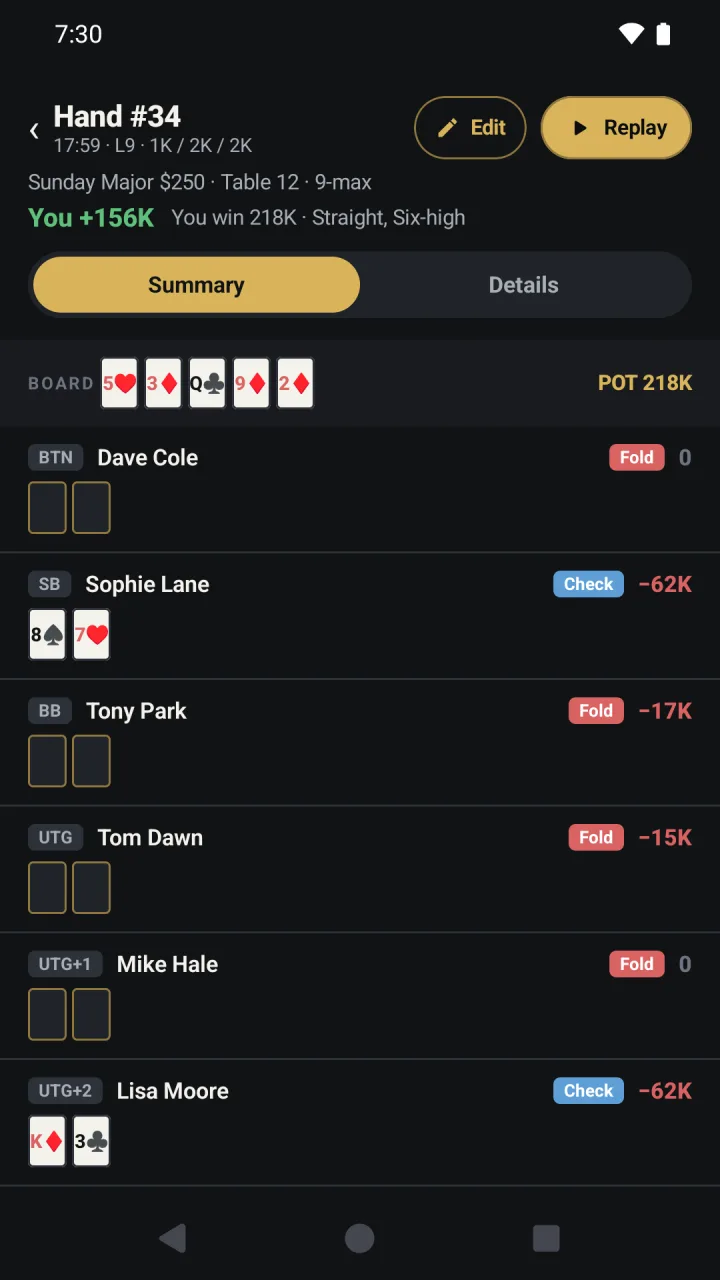
With SSS Poker you record each hand at the table, positions, actions and sizes on every street, and open it later in Hand Detail, so the c-bets you saw are there to go back to. Player profiles keep your notes next to the free stats overview (VPIP, PFR, 3-Bet, Agg%), and Pro adds full player analytics with the hands behind each stat. The best live poker stats hub covers the other numbers worth watching.