
3-Bet Percentage in Live Poker: Why It's Rare and How to Read It
3-Bet % only gets a chance when someone opens in front of the player, so it fills up slowly. Here's how to read it live without trusting one re-raise too much.
Short answer: 3-Bet % is how often a player re-raises when someone has already opened in front of them. It only gets a chance in those spots, so after a whole night it might rest on a few dozen decisions, or just a handful. Read it as “8 of 41”, not “20%”, and it becomes useful. Read it alone and one big hand can fool you.
What counts as a 3-bet?
Someone opens, the player re-raises. That’s a 3-bet: the blinds are the first bet, the open is the second, the re-raise is the third.
For the stat, a hand counts as a chance only when:
- someone made an open raise before the player acted,
- the player could still legally re-raise,
- and you actually saw what they did.
If they re-raised, it’s a hit. If they folded or called, it’s a miss.
| Situation at $1/$3 | Counts for 3-Bet? |
|---|---|
| CO opens to 15, player on the BTN makes it 45 | Yes, a hit |
| CO opens to 15, player calls on the BTN | Yes, a miss |
| CO opens to 15, player folds in the BB | Yes, a miss |
| Folds to the player, he opens to 15 | No, there was no open to re-raise |
| Three limpers, player raises to 20 | No, that’s an iso-raise, not a 3-bet |
| Open to 15, one caller, player raises to 70 | Yes, a hit (a squeeze is a 3-bet with callers in between) |
| You went to the bar and missed his action | No, you didn’t see the decision |
A 3-bet also counts toward VPIP and PFR. If you want to know how those two fit, see PFR vs VPIP.
Why is 3-bet percentage so rare live?
Because it needs somebody else to open first. A typical live table limps a lot, and when nobody raises, nobody can 3-bet.
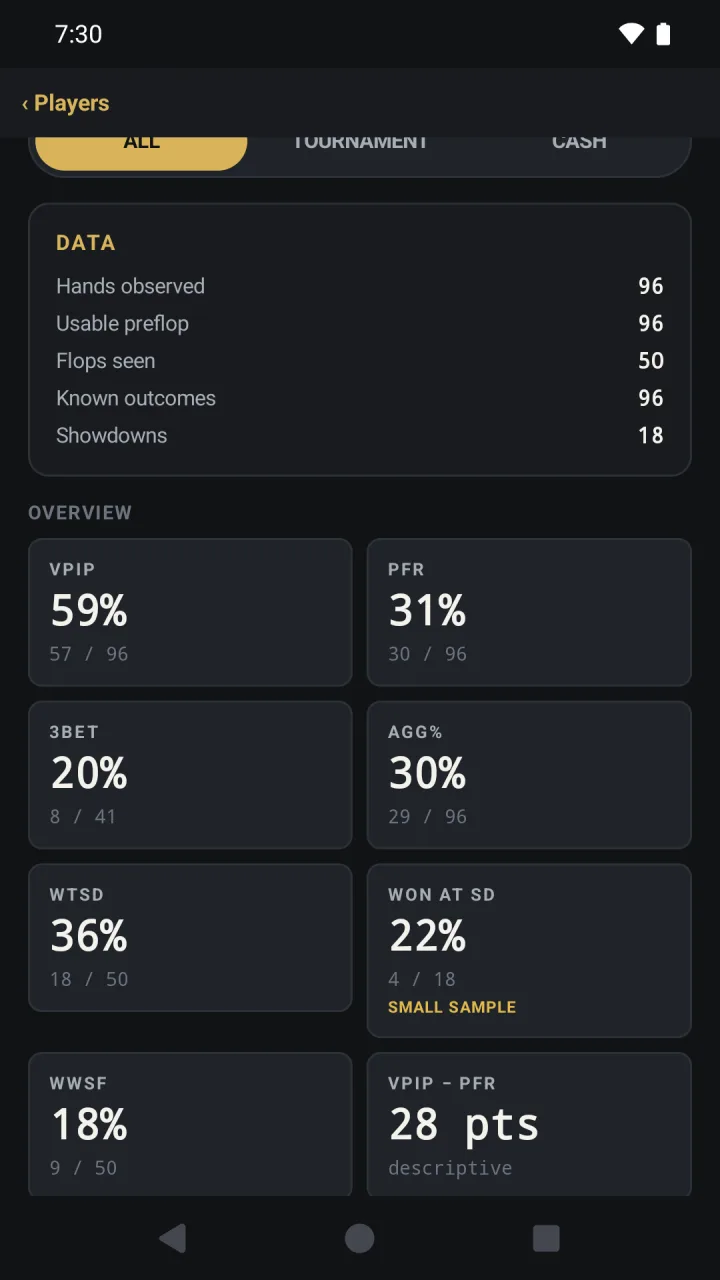
Look at a real profile: a player seen for 96 hands faced an open only 41 times. VPIP and PFR had 96 chances each. 3-Bet had 41.
And in a loose $1/$2 where half the pots are limped, the number of chances can be even smaller. Then there’s the fact that most players don’t 3-bet much live. A handful of re-raises across a few dozen chances is normal.
So a 3-Bet % is always built on fewer decisions than the stats around it, even when the hand count at the top of the profile looks big.
How many chances before 3-Bet % means anything?
More than you think. Watch how far one decision moves it:
| Chances | 3-bets | 3-Bet % | After one more 3-bet |
|---|---|---|---|
| 8 | 1 | 13% | 2 / 9 = 22% |
| 41 | 8 | 20% | 9 / 42 = 21% |
| 100 | 6 | 6% | 7 / 101 = 7% |
At 8 chances, one re-raise jumps the number nine points. At 41 it moves one point. Even then, a single session where he picked up kings twice can change the picture.
Live, the 3-bets you see are also lopsided. You’re more likely to remember and record the hand where seat 3 re-raised to 60 than the twenty times he folded to an open. Record only the action hands and his 3-Bet % climbs.
There’s no hand count where the stat suddenly becomes “true”. Our sample size guide explains why the count matters more than any rule of thumb.
How do you read a 3-bet live?
The number is a starting point. These questions matter as much:
Who opened? A 3-bet against a tight UTG open means something very different from a 3-bet against the button who opens every hand. Most players re-raise a late-position open far more lightly.
Where was the 3-bettor sitting? Re-raising from the button against a cutoff open is a common spot. Re-raising out of the small blind against an early open is usually a strong hand in a lot of live games.
How big was it? You’ll see sizes all over the place live. A player who makes it 3x on the button and 5x out of position is normal. A player whose size jumps with his best hands is giving you information.
What has he shown down? Two shown 3-bets with QQ and AK tell you more about his range than the percentage. Write the hand down.
What does a low or high 3-Bet % usually mean?
Treat this as rough. Games differ a lot, and so do the numbers:
- Very low, over a decent count (say 2 or 3 of 50). Usually a player who only re-raises with big pairs and AK. When he 3-bets, believe him. Calling his 3-bets light is usually a mistake.
- Moderate. Re-raises some strong hands and mixes in a few others, often in position. Harder to read from the number alone.
- High, over a decent count. Re-raises a wide range, often to isolate or to push players off limps and calls. Calling more or 4-betting a little lighter can make sense against him, if the count backs it up.
In many low-stakes live games, most players sit at the low end. That’s a tendency, not a rule. A straddled $2/$5 with aggressive regulars can look nothing like a Tuesday $1/$2.
What mistakes do players make with 3-Bet %?
- Trusting a tiny count. “He 3-bet me twice tonight, he’s a maniac.” Two hits from five chances is 40%, and also two hands.
- Using total hands as the sample. 96 hands seen doesn’t mean 96 chances to 3-bet. Look at the count under the stat.
- Ignoring who opened. A 3-bet against the loose button opener is not the same move as a 3-bet against the nit.
- Forgetting tournament stacks. At 20 big blinds, a 3-bet is often all in. That’s a different decision from a 3-bet 200 deep.
Your notes fill the gaps the number leaves: “3-bet BTN vs CO open, 15 to 50, showed AQs”. Our player notes guide shows how, and the live poker stats guide shows where 3-Bet sits next to VPIP, PFR and the rest.
Where SSS Poker fits
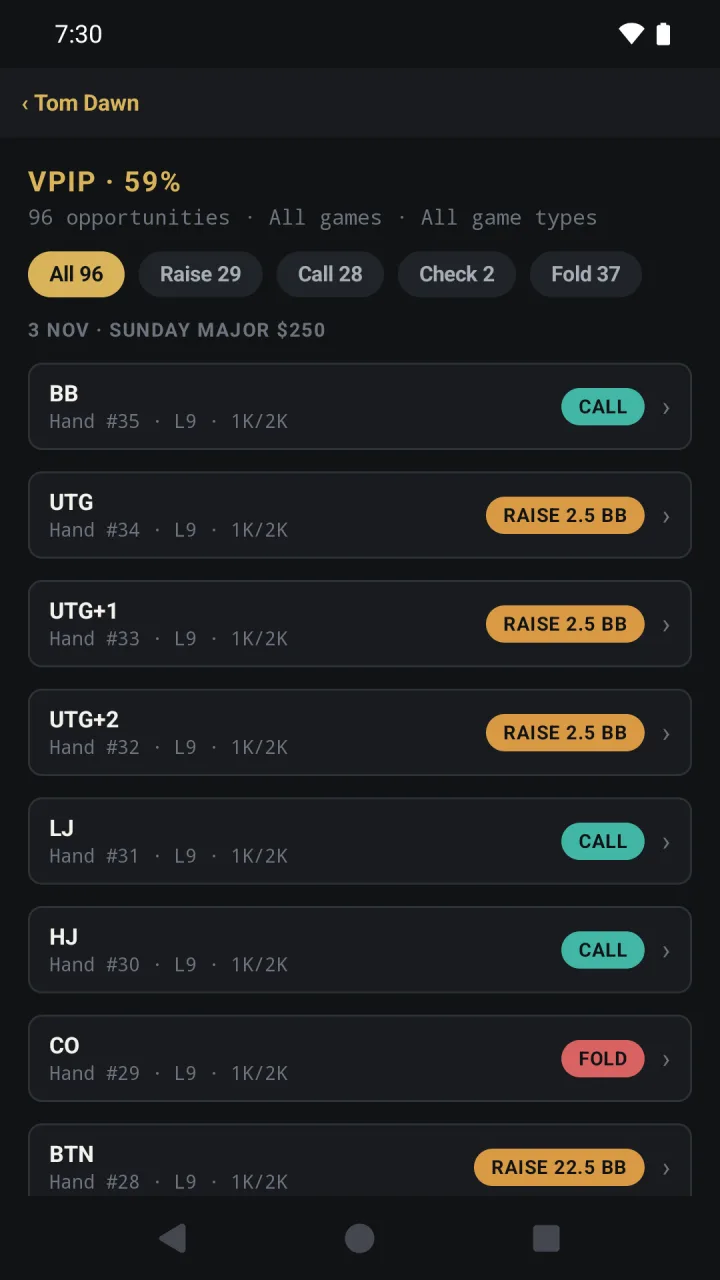
SSS Poker counts 3-Bet only in hands where the player faced an open and you saw the decision, and shows it with its count, like 8 / 41, next to VPIP, PFR and Agg%. That overview is free. With Pro you get full player analytics, including 3-Bet by position, and can open the hands behind any stat to check the spots yourself. How player stats work has the full rules.
 PRO