
The Live Poker Stats Worth Watching (and the Ones to Ignore)
Live, you'll never see enough hands for a full online HUD. Eight numbers, read with their hand counts, cover most of what you can learn about a player.
Short answer: at a live table, the stats worth watching are VPIP, PFR, the gap between them, 3-Bet, Agg%, WTSD, Won at SD and c-bet. Together they tell you how often someone plays, how they get in, how hard they push after the flop and how far they take hands. None of them means much without the number of hands behind it, so read every percentage with its count.
Why not track every stat like an online HUD?
Online, a tracker sees thousands of hands a week. Live, you might see 30 hands an hour, and you won’t write down all of them. A stat that needs a rare spot, like folding to a 4-bet, may never get enough chances to say anything.
So you pick numbers that fill up quickly or answer a question you actually face at the table. The eight below do that. Everything else is in the poker stats glossary.
VPIP: how often does this player get involved?
VPIP is the share of hands where a player chose to put chips in preflop: a limp, a call or a raise. Posting a blind doesn’t count, and neither does checking the big blind.
It’s the first stat to look at because it fills up fastest. Almost every hand is a chance. If the guy in seat 6 at your $1/$3 game has played 22 of 40 hands, you already know he’s in a lot of pots, even if you don’t know how well he plays them.
Deep dive: VPIP in live poker.
PFR: how often do they come in raising?
PFR is the share of hands where a player raised preflop: an open, a 3-bet, any raise. It’s always at or below VPIP, because every raise is also a way of putting money in.
PFR alone tells you how often someone takes the lead. Next to VPIP, it tells you much more.
The VPIP and PFR gap: callers or raisers?
Subtract PFR from VPIP and you get the gap. A player with 30% VPIP and 25% PFR raises most hands he plays. A player with 30% VPIP and 6% PFR mostly limps and calls.
That difference changes how you play against them. The small-gap player is the one who’ll make you pay to see flops. The big-gap player lets you in cheaply and then you have to figure out what his calls mean. It’s the most useful single read you can build live.
Deep dive: PFR vs VPIP in live poker.
3-Bet: who re-raises, and how often?
3-Bet is how often a player re-raises when someone has already opened in front of them. The chance only comes when there’s an open before they act, so it fills up slowly.
After 60 hands with a $2/$5 regular, you might have only 9 or 10 spots where he could 3-bet. If he’s done it twice, that’s 2 of 9, which can easily swing to 1 of 10 or 4 of 12 by next week. Still worth noting, because a player who never 3-bets is giving you real information when he finally does.
Deep dive: 3-Bet percentage in live poker.
Agg%: do they bet and raise, or check and call?
Agg% (aggression frequency) is the share of a player’s postflop actions that are bets or raises, out of bets, raises, calls and checks. Folds don’t count. It answers a simple question: when this player is still in the hand after the flop, does he push or does he follow?
You’ll also see the aggression factor (AF), which divides bets and raises by calls only. It jumps around badly on small samples, which is why Agg% tends to be the better live number.
Deep dive: Agg% vs aggression factor.
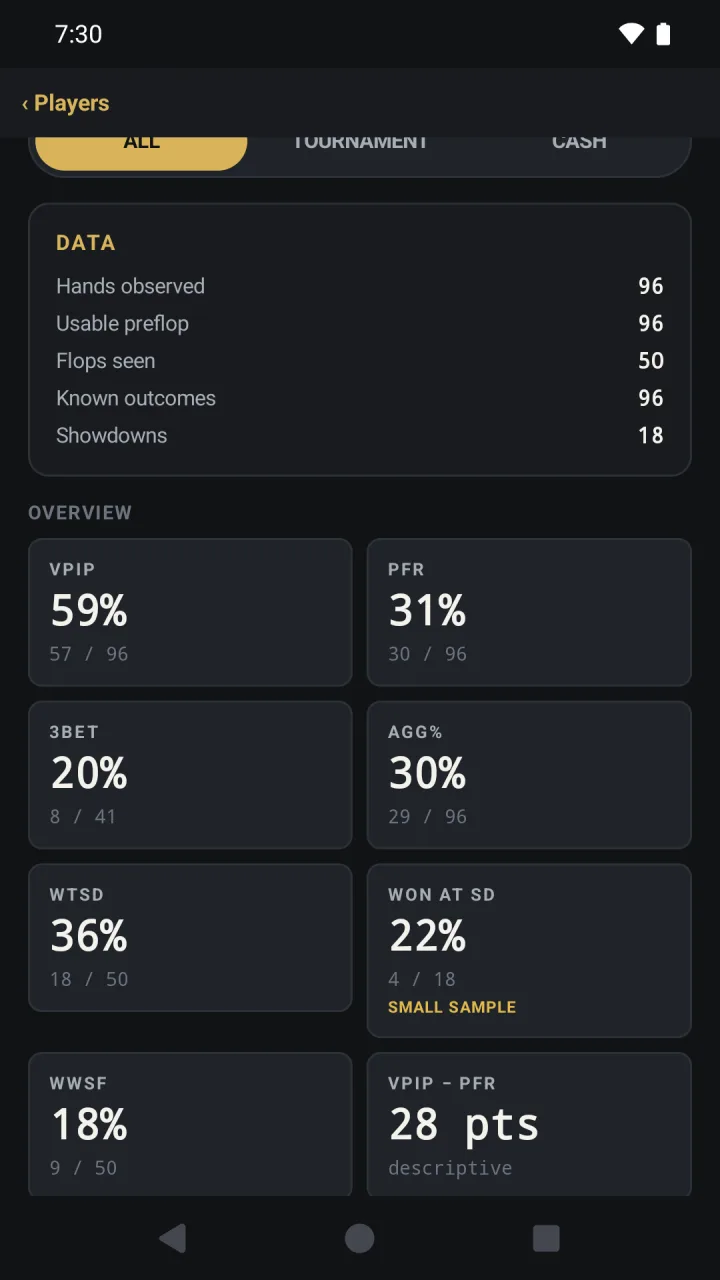
WTSD and Won at SD: how far do they take hands?
WTSD (went to showdown) is how often a player who saw the flop ended up showing cards. Won at SD is how often they won once they got there. Read the two together.
High WTSD and low Won at SD is the classic calling station: he goes to the river a lot with hands that don’t win. Low WTSD and high Won at SD is someone who mostly gets there with the goods, so his river call or raise means something. WWSF (won when saw flop) adds how often they take the pot at all, showdown or not.
Showdowns are rare, so Won at SD is the slowest stat here. 4 wins in 18 showdowns is a hint, nothing more.
Deep dive: WTSD and Won at SD in live poker.
C-bet: does the preflop raiser keep betting the flop?
C-bet (continuation bet) is how often the preflop raiser bets the flop when nobody has bet before him. Its partner, fold to c-bet, is how often a player gives up when someone c-bets into them.
Live, these are some of the most practical numbers there are. If the $1/$2 regular who opened from the CO bets every flop, your floats and check-raises get better. If he checks back half the time, his bets carry more weight.
Deep dive: continuation bet percentage in live poker.
How many hands before any of this means something?
There’s no magic number. What matters is how many times the player faced that exact decision. VPIP gets a chance almost every hand. 3-Bet gets one only when someone opens first. Won at SD gets one only when the hand reaches showdown.
That’s why the count matters more than the percentage. A player at 40% VPIP over 10 hands has played 4 hands. One more hand played and he’s at 45%; one more fold and he’s at 36%. At 40 of 100, one hand barely moves it.
Live data also has two blind spots. You only see the nights you play together, from your seat, and most people record the interesting pots and skip the folded orbits. Record only big pots and you get big-pot stats. More in how many hands live stats need.
Are there “good” numbers for each stat?
Not ones you can trust across games. A 35% VPIP is loose in a nine-handed game with no straddle and fairly normal in a six-handed game where the button straddles every orbit. Stack depth, table size and tournament vs cash all move every stat on this page.
If you want rough reference points, compare players in the same game you play, over similar counts. And keep notes on what you actually saw, like “limped UTG and called 15 with K-9 offsuit”. Those details often beat the numbers; see live poker player notes. For your own game, the list looks a bit different: see poker stats to track your game.
Where SSS Poker fits
SSS Poker builds player stats from the hands you record and shows the count next to each one. The free overview covers VPIP, PFR, the gap, 3-Bet and Agg%, and the profile also shows WTSD, Won at SD and WWSF, with small samples labelled. With Pro you get full player analytics by position and can tap a stat to see the exact hands behind it; how player stats work explains every count.