
Poker Aggression Frequency vs Aggression Factor: Which to Trust Live
Aggression frequency and aggression factor both try to say how often a player bets and raises after the flop. Live, one of them is a lot steadier than the other.
Short answer: aggression frequency (often written Agg% or AFq) is the share of a player’s postflop actions that are bets or raises. Aggression factor (AF) divides bets and raises by calls. Both try to answer “does this player push or follow?”, but live, with small counts, Agg% is much steadier. AF can swing wildly off a couple of calls, so trust it only when there’s a lot behind it.
What’s the difference between aggression frequency and aggression factor?
They use the same ingredients and mix them differently.
| Stat | How it’s worked out | Looks like |
|---|---|---|
| Aggression frequency (Agg%) | (Bets + raises) ÷ (bets + raises + calls + checks), folds left out | A percentage, 0 to 100% |
| Aggression factor (AF) | (Bets + raises) ÷ calls | A ratio, like 1.5 or 3.0 |
Trackers don’t all agree on the details. Some count folds in aggression frequency, some count checks, some count both. Before you compare a number from one place with a number from another, check what it divides by. SSS Poker’s Agg% uses the formula above: checks in, folds out.
The key difference is the bottom half. Agg% divides by almost everything the player did. AF divides by calls only, so it ignores checks completely.
Why does aggression factor jump around so much?
Because calls are rare. Plenty of players bet or check far more often than they call.
Say the regular in seat 2 at your $1/$3 game has made 14 postflop decisions you saw:
| Bets / raises | Calls | Checks | Agg% | AF |
|---|---|---|---|---|
| 6 | 2 | 6 | 6 of 14, 43% | 6 ÷ 2 = 3.0 |
| 6 | 1 | 7 | 6 of 14, 43% | 6 ÷ 1 = 6.0 |
| 6 | 0 | 8 | 6 of 14, 43% | can’t be worked out |
Just arithmetic to show the idea, not data from any player.
One call that became a check doubled his AF, and with no calls at all there’s no number. His Agg% didn’t move, because it still counts the same 6 aggressive actions out of the same 14.
That’s why a decent app shouldn’t show a made-up AF like “infinity” or “6.0 from one call”. It’s also why AF is fine on a big online database and shaky on 40 live hands.
So which one should you trust live?
Agg%, mostly. It always sits between 0 and 100%, every postflop action you saw counts toward it, and one odd hand only nudges it.
AF still has a use: once a player has a good number of calls behind it, it tells you something Agg% doesn’t. AF of 4 means “when this guy doesn’t check or fold, he’s raising, not calling”. That’s a real read. Just look at how many calls it’s built on first. AF from 3 calls is a coin flip dressed up as a stat.
How do you read Agg% at the table?
Compare players in the same game. A high Agg% next to everyone else’s means this player bets and raises more than the table after the flop. A low one means they mostly check and call.
Then put it next to the other numbers:
- High VPIP, low Agg%. Gets in a lot, then checks and calls. Often the player who’s easy to value bet and hard to bluff.
- Low VPIP, high Agg%. Picks few hands and pushes them. When she bets three streets at $2/$5, believe her more than you’d believe the loose guy.
- High Agg%, high WWSF, low WTSD. Wins a lot of pots without a showdown. Bets, and people fold. See WTSD and Won at SD for how those fit.
- High Agg% but low Won at SD. Bets a lot and loses when called. Could be bluffing too much, or just running into better hands. Look at the hands.
Some trackers also split aggression by street. A player who fires the flop every time and then checks the turn is very different from one who saves the big bets for the river. A lot of that flop betting is c-betting, which has its own guide.
Is there a “normal” aggression number?
Not one you should sort people with. You’ll see rough online figures quoted, but live games are different: more limped pots, more multiway flops, more players who call and see. In a five-way pot, even a fairly aggressive player checks a lot, because someone else already bet.
Use any range as a rough idea for a typical game. Your own table is the real comparison: who bets more than the others, who bets less, over similar counts.
How many hands does Agg% need?
More than VPIP, fewer than showdown stats. Agg% only counts postflop actions, so a player who folds preflop gives you nothing. A tight player might give you a handful of postflop actions per hour.
The count matters as much as the number:
| Aggressive actions | Postflop actions | Agg% | |
|---|---|---|---|
| Player A | 4 | 10 | 40% |
| Player B | 40 | 100 | 40% |
One more bet takes Player A to 5 of 11, 45%. Player B barely moves. A 40% from ten actions might be one hand where he bet flop, turn and river with the nuts.
Live data is also selective. You see the hands you were there for and the ones you wrote down. Record only the big pots and you’ll mostly record the hands where someone was betting. More on that in how many hands live stats need.
What mistakes do players make with aggression stats?
- Treating aggression as skill. A high number says how often someone bets, not whether the bets make sense.
- Trusting AF on a tiny count. “AF 5” from one call means nothing.
- Mixing up formulas. Two trackers can show different numbers for the same player because they count folds or checks differently.
- Forgetting the spot. Multiway pots, short stacks and tournament pressure all change how often anyone bets.
Where SSS Poker fits
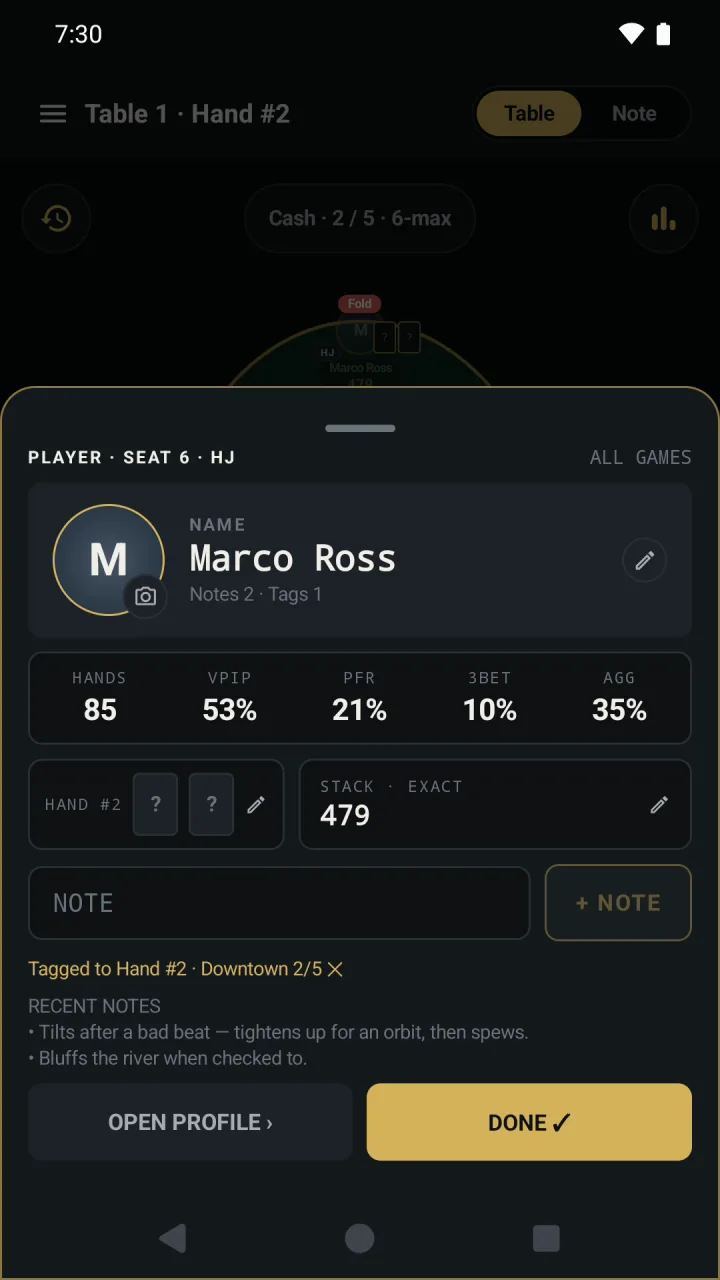
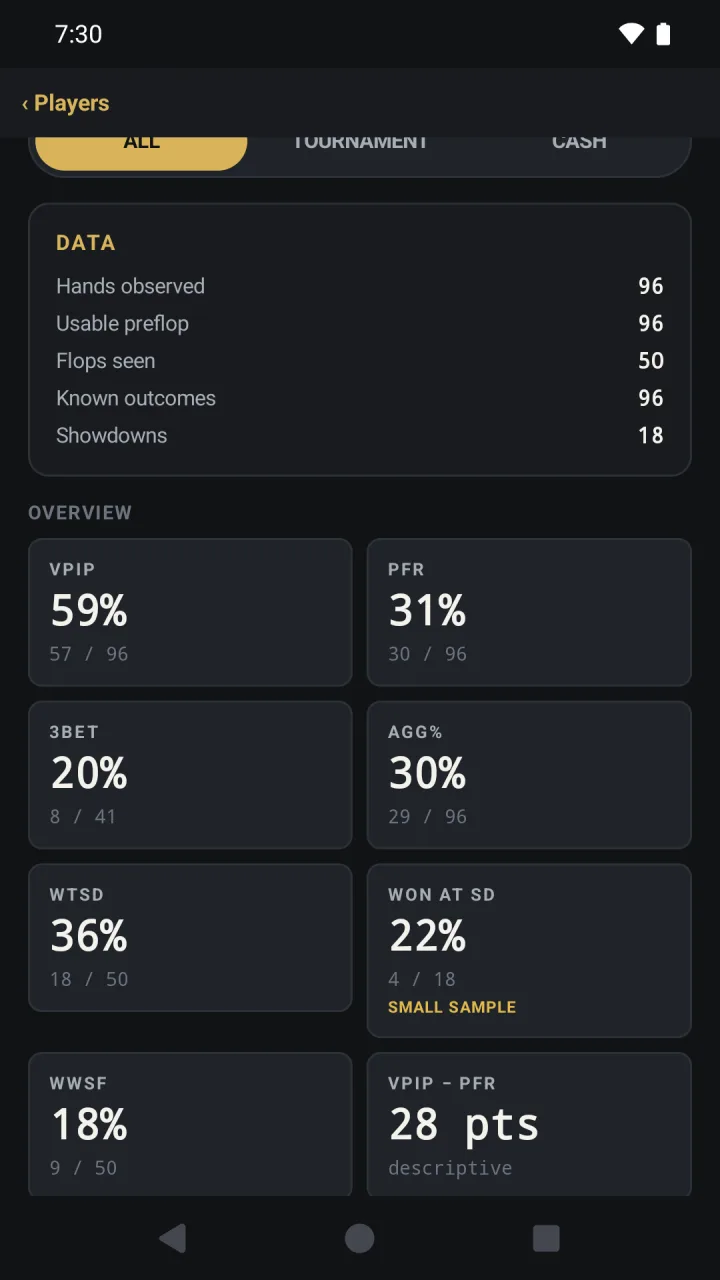
SSS Poker counts Agg% from the postflop actions you record and shows the count beside it, like 29 / 96, on the player profile and on the player card at the table. With Pro you get full player analytics and can open the hands behind a stat. The best live poker stats hub covers the rest of the numbers worth watching.