
PFR vs VPIP in Live Poker: How to Read the Gap
VPIP says how often a player gets involved. PFR says how often they raise. The space between the two tells you whether you're up against a caller or a raiser.
Short answer: VPIP is how often a player puts chips in preflop by choice. PFR is how often they raise preflop. The gap between them is roughly how often they limp or call instead of raising: a small gap means they mostly come in with a raise, a big gap means they mostly call. Read both with the number of hands behind them, because live samples are small.
What’s the difference between VPIP and PFR?
VPIP (Voluntarily Put money In Pot) counts every hand where a player chose to add chips before the flop: a limp, a call, a raise, a 3-bet. Posting a blind or checking the big blind doesn’t count. Our VPIP guide covers the details.
PFR (Preflop Raise) counts only the hands where they raised preflop: an open, a 3-bet, a 4-bet or an all-in raise.
So every PFR hand is also a VPIP hand. PFR can never be bigger than VPIP over the same hands. The interesting part is how much smaller it is.
What does the gap between VPIP and PFR tell you?
Take VPIP, subtract PFR, and you get the share of hands where the player got involved without raising. That’s limps, calls of an open, calls of a 3-bet, and big-blind calls.
Two players at your $1/$3 table, both at 30% VPIP:
| VPIP | PFR | Gap | What it usually looks like | |
|---|---|---|---|---|
| Seat 2 | 30% | 25% | 5 pts | Raises almost every hand he plays. Rarely limps. |
| Seat 7 | 30% | 6% | 24 pts | Limps and calls a lot. Raises mainly with big hands. |
Same VPIP, very different players. Seat 2 puts pressure on you before the flop. Seat 7 lets you in cheaply and tells you a lot when he finally does raise.
That’s why VPIP alone can fool you. A player who plays 30% of hands by raising is nothing like a player who plays 30% by limping.
How do you use the gap at the table?
A big gap: the caller. You’re on the button at $1/$2, seat 4 limps for the third orbit in a row. His VPIP is high and his PFR is low. Raising his limps for value with a wider range makes sense, because he often calls and plays the hand out of position. And when he does raise preflop, take it seriously: it’s the rare part of his range.
A small gap: the raiser. Seat 2 opens a lot and almost never limps. Calling his opens with hands that play badly, like weak offsuit aces, gets you into trouble. You’ll see more 3-bets and folds against him than flat calls. His raises cover a wider range than the limper’s, so a raise from him means less.
Both low: the nit. VPIP 14%, PFR 11%. Small gap, small numbers. He doesn’t play much, and when he does, he’s strong. Steal his blinds and give his raises respect.
Both high, big gap: the loose caller. VPIP 55%, PFR 8%. This is the player who sees lots of flops. Bluffing him preflop is pointless; making good hands and betting them is the plan.
These are tendencies, not labels. The gap tells you what a player usually does, not what he’s doing this hand.
How big a gap is “big”?
There’s no chart that works everywhere, so treat any number as rough.
In a lot of $1/$2 and $1/$3 games, a gap of a few points means someone raises nearly everything they play. A gap in the teens or more usually means plenty of limping and calling. But the game shapes this:
- Straddles and limped pots. With a straddle every orbit and five people seeing the flop, everyone calls more. The whole table’s gap goes up.
- Blinds. Calling a raise from the big blind adds to VPIP but not PFR. If you saw a player mostly in the blinds, his gap looks bigger than it really is.
- Table size. Short-handed games push everyone toward raising, which shrinks gaps.
- Tournaments. Short stacks shove or fold, which closes the gap. Deep early levels look more like cash.
Compare players from the same game. A 12-point gap might be tight-ish in a loose, straddled $2/$5 and loose in a nitty $1/$2.
How many hands before the gap means something?
VPIP and PFR fill up fast, because almost every hand you see gives each one a chance. Still, a gap built on a single orbit is mostly noise.
| VPIP | PFR | Gap | |
|---|---|---|---|
| After 10 hands | 6 / 10 = 60% | 3 / 10 = 30% | 30 pts |
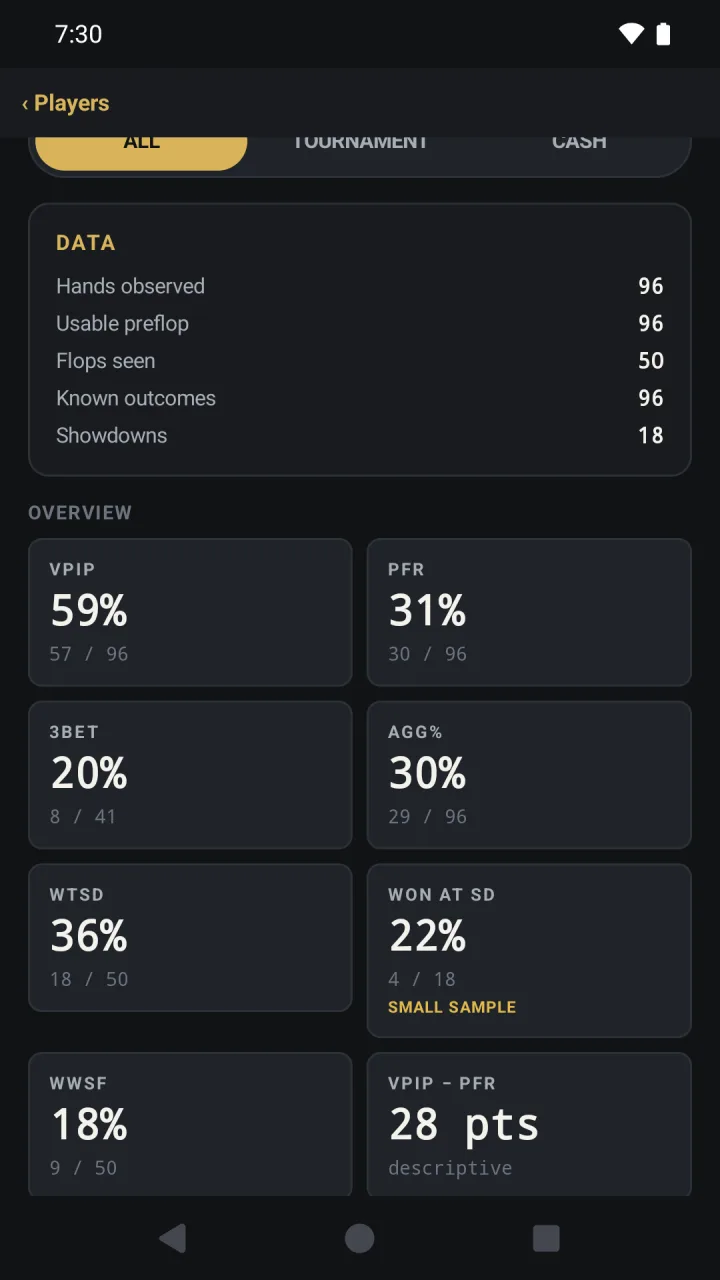
| After 96 hands | 57 / 96 = 59% | 30 / 96 = 31% | 28 pts |
The gap looks the same. But after 10 hands, one more limp makes it 7 of 11 and 3 of 11, and the gap jumps to 36 points. After 96 hands, one more limp moves it about a point. Same percentages, very different weight. Here’s more on how many hands you need.
Two more things about live samples:
- You only see some hands. If you only write down the big pots, you’ll catch the player raising more than he really does, and the gap shrinks.
- The counts can differ. Say seat 6 limps and you miss the rest of preflop. You know he played the hand, so it counts for VPIP. You don’t know whether he raised later, so it stays out of PFR. That’s normal, and it’s why each stat should show its own count.
Does position change the gap?
A lot. Most players raise more on the button and cutoff and call more from the blinds. A player can look like a raiser if you mostly saw him on the button, and like a caller if you mostly saw him in the big blind.
If you can, look at VPIP and PFR by position. A player who raises the button but limps from early position is a different read from one who limps everywhere.
What mistakes do players make with VPIP and PFR?
- Reading VPIP alone. “He’s at 40%, he’s loose” says nothing about whether he’s loose-passive or loose-aggressive. Look at PFR first.
- Trusting a gap from one orbit. Three limps in ten hands might just be three hands he wanted to see cheaply.
- Ignoring the blinds. Big-blind calls inflate everyone’s gap.
- Forgetting people change. The quiet limper who just won a big pot might start raising every hand. Your stat lags behind; your eyes don’t.
A short note helps the number: “limps UTG, raised only with QQ+ so far, $1/$3, 150 deep”. Our player notes guide shows how to keep those, and the live poker stats guide shows where VPIP and PFR fit with the rest.
Where SSS Poker fits
SSS Poker builds VPIP and PFR from the hands you record and shows the gap next to them, each with its count, so you see 57 / 96 and not just 59%. That overview is free. With Pro you get full player analytics, including VPIP and PFR by position, and can open the hands behind a stat; how player stats work explains how each count is built.