
WTSD and W$SD in Poker: Reading Showdown Stats Live
WTSD says how often a player gets to showdown after the flop. Won at SD says how often they win when they do. Read them together, with WWSF, and you start to see who calls too much and who only shows up with it.
Short answer: WTSD (Went to Showdown) is how often a player who saw the flop ended up turning their cards over at showdown. W$SD, or Won at SD, is how often they won the pot once they got there. One number tells you how far they go with a hand, the other tells you what they’re holding when they do, so you read them together, never alone.
What do WTSD, Won at SD and WWSF actually count?
All three start from the flop. A hand where the player folded preflop doesn’t count for any of them.
| Stat | Counts hands where | Hit when |
|---|---|---|
| WTSD | They saw the flop and you know whether the hand reached showdown | They got to showdown |
| Won at SD (W$SD) | You saw a showdown they were in, and you know who won | They won all or part of the pot |
| WWSF (won when saw flop) | They saw the flop and you know who won | They won all or part of the pot, with or without a showdown |
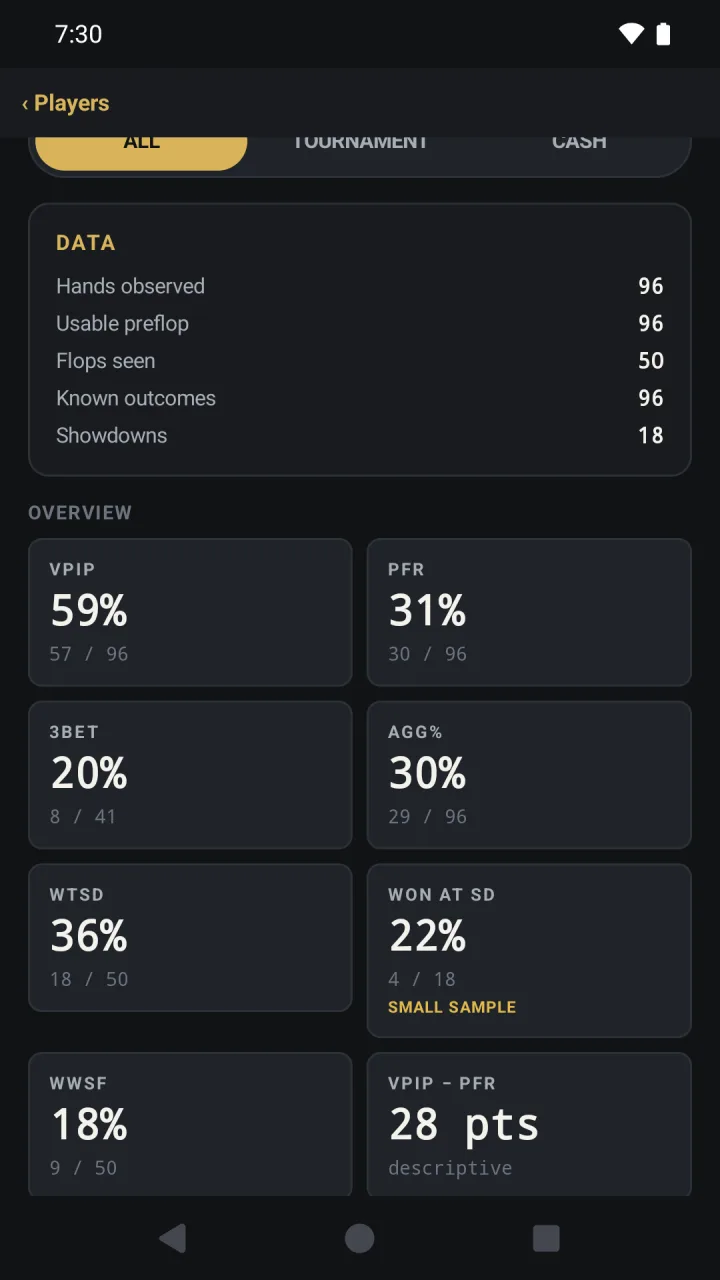
So each stat has its own bottom number. A player can see 50 flops with you, reach showdown 18 times, and win 4 of those. That’s WTSD 18 of 50, Won at SD 4 of 18.
If you left the table before a hand ended, you don’t know how it finished. That hand shouldn’t count for any of these. Guessing “probably folded” quietly drags WTSD down.
How do you read WTSD and Won at SD together?
Think of a simple grid. High or low is always relative to the players in your own game.
| Wins often at showdown | Wins rarely at showdown | |
|---|---|---|
| Goes to showdown a lot | Bluff catcher who’s usually right, or a player getting paid with strong hands | Calling station: calls down with second pair and loses |
| Rarely goes to showdown | Nit: gives up a lot, but when cards go over, they’ve got it | Someone who bets and gives up: bluffs, then folds when called |
The calling station. At your $1/$2 game, the guy in seat 7 calls the flop, calls the turn and calls the river with K-9 on a K-Q-5-8-2 board. He gets there a lot, and he loses a lot when he does. High WTSD, low Won at SD.
The bluff catcher. Also goes to showdown often, but picks better spots. She calls the river with a pair when the story doesn’t add up, and she’s right more than she’s wrong. High WTSD, decent Won at SD.
The nit. Folds the turn without a strong hand, so you rarely see his cards. When you do, it’s a set. Low WTSD, high Won at SD.
The grid is a starting point for a question, not an answer. A low Won at SD can also mean a player who bluffs a lot and gets called. That’s why you want the third number.
Why add WWSF?
WWSF counts every pot a player wins after the flop, including the ones where everyone else folded. That’s the part showdown stats can’t see.
Two players can both win 45% at showdown. One also wins a lot of pots where nobody calls: he bets, everyone folds. His WWSF is well above his showdown wins. The other only ever wins by having the best hand at the end, so his WWSF tracks his showdowns closely.
A high WWSF with a modest WTSD usually means a player who takes pots down with bets. Pair it with aggression stats and the picture gets clearer: lots of betting, lots of pots won without a showdown.
A low WWSF with a high WTSD is the classic station: sees flops, calls along, and wins mostly when the river happens to help.
Is there a “normal” WTSD or Won at SD?
Only roughly. You’ll see online numbers quoted somewhere in the high 20s for WTSD and around 50% for Won at SD. Treat those as a loose compass, not a chart to sort people with.
Live games move them a lot:
- Multiway pots. In a $2/$5 game where four people see every flop, each player reaches showdown less often and wins less often when they do.
- Straddles and deep stacks. Bigger pots preflop mean more people stick around to the river.
- Your table. A loose Friday game and a tight Tuesday game have different “normal” numbers.
The useful comparison is player against player in the same game, over similar counts. “She goes to showdown more than anyone else at this table” is something you can use. “Her WTSD is above 30% so she’s a station” usually isn’t.
How many hands before showdown stats mean anything?
A lot more than you think. These are slow stats.
VPIP gets a chance almost every hand. WTSD only gets one when the player sees a flop. Won at SD only gets one when the hand reaches showdown, which might be once or twice an orbit across the whole table.
Look at the difference:
| Showdowns | Won | Won at SD | One more win | |
|---|---|---|---|---|
| Player A | 18 | 4 | 22% | 5 of 19, 26% |
| Player B | 180 | 40 | 22% | 41 of 181, 23% |
Same 22%, very different weight. Player A’s number swings four points on one hand. And 18 showdowns can easily come from one long Saturday night with one run of cards.
Live data is also selective. You see the showdowns that happened while you were at the table, from your seat, in the hands you chose to record. If you mostly log big pots, you’ll mostly log big showdowns, and those aren’t a fair slice of anyone’s game. Our guide to live poker stats sample size goes deeper on this.
What mistakes do players make with showdown stats?
- Reading Won at SD on its own. 70% sounds like a great player. It might be a nit who only shows down the nuts and folds everything else.
- Counting hands you didn’t see finish. If you missed the river, you don’t know if they got to showdown.
- Forgetting the count. “Wins 75% at showdown” is 3 of 4. That’s three hands.
- Calling someone a station from one memorable hand. One hero call with fourth pair is a story, not a stat. Write it down as a note and let the numbers catch up. The player notes guide shows how.
When a number surprises you, look at the hands behind it. Which showdowns did he lose? Was it second pair calling down, or a busted draw he bet with three times? Those are very different players with the same stat.
Where SSS Poker fits
SSS Poker builds WTSD, Won at SD and WWSF from the hands you record and shows each one with its own count, like 4 / 18, plus a small sample label when the count is low. They sit on the player profile next to VPIP, PFR, 3-Bet and Agg%. With Pro you can open the hands behind a stat to see which showdowns built it. The hub of live poker stats covers the other numbers worth watching, and how player stats work explains every count.