
Poker Stats to Track for Your Own Live Game
Your own numbers can show you habits you don't notice at the table, as long as you record the boring hands too and don't read too much into one good night.
Short answer: for your own live game, track your VPIP and PFR by position, how often you 3-bet, how often you c-bet, how often you go to showdown and win there, and your results per hour. Those few numbers show the habits you can’t feel at the table, like calling too much from the blinds. They only work if you record the hands you fold too, and they need far more hands than you’d think.
Why track your own stats at all?
Because memory lies in your favour. You remember the set you flopped and the bluff that got through. You forget the 14 times you called a raise from the small blind with K-9 and check-folded the flop.
Your own stats are also easier to trust than an opponent’s. You know your cards, you know why you acted, and you’re there for every hand you play. The catch is the recording, not the reading.
Why do the folded hands matter so much?
Because every stat is a fraction, and the folds are most of the bottom half. Log only the hands you played and your VPIP is 100%. Log only the big pots and every number describes your big pots, not your game.
You don’t need full detail for a fold. Position and “folded preflop” is enough. If writing down every orbit is too much, pick one night a month and record everything, then read the stats from those nights only.
Which preflop numbers should you watch?
VPIP and PFR by position. Overall VPIP hides more than it shows. 24% overall could be a sensible 15% from UTG and 40% on the button, or the same number everywhere, which is a problem. Split it by seat and look for leaks: a common leak is playing too many hands from the small blind and the early seats.
The gap between them. If your VPIP is 28% and your PFR is 11%, you’re calling a lot of raises and limping a lot of pots. That’s often the clearest leak in a live player’s numbers, and it’s one you can see after a few sessions because VPIP and PFR fill up fast. More in PFR vs VPIP.
3-Bet. At a $1/$3 game where everyone flats, it’s easy to go a whole night without 3-betting. Check how often you re-raise when someone opens in front of you, and from which seats. If it’s 1 of 25, your raises are probably all big pairs and the table knows it. See 3-Bet percentage.
Which postflop numbers should you watch?
C-bet. How often you bet the flop after raising preflop. A lot of live players c-bet nearly every flop at $1/$2 and then give up on the turn. If your c-bet is very high and your turn bet is low, regulars can just float you. The c-bet guide goes through how to read it.
WTSD and Won at SD together. WTSD is how often you reach showdown after seeing a flop; Won at SD is how often you win there. If you go to showdown a lot and win less than you lose, you may be paying off too many rivers. If you rarely reach showdown but almost always win when you do, you might be folding too often to pressure. Both stats need many showdowns, so read them over months, not weeks. Details in WTSD and Won at SD.
How many hands before your numbers mean anything?
More than you’d hope. Live, you see about 30 hands an hour. Five four-hour sessions is roughly 600 hands. That’s plenty for VPIP and PFR, a decent start for VPIP by position, and still thin for 3-Bet, c-bet and anything about showdowns.
Picture your button VPIP after one night: 4 of 10, so 40%. One more hand played makes it 45%, one more fold makes it 36%. After 100 button hands at 40 of 100, one hand moves it by less than a point. Same 40%, completely different weight. Always look at the count; how many hands live stats need goes deeper.
Also, keep games apart. Your numbers in a 9-handed $1/$3 game with no straddle won’t match a 6-handed $2/$5 with a button straddle, and tournament stacks change everything again.
Results per hour or per 100 hands?
Live, results per hour is the honest one. You know when you sat down and when you cashed out, so +$450 over 5 hours is $90 an hour, from that one night.
Per 100 hands (BB/100) is the online standard, but live you rarely know exactly how many hands you were dealt. If you do count, it’s useful for comparing your game across stakes, since it’s in big blinds. Just remember that at 30 hands an hour, a 5-hour session is only about 150 hands.
Either way, results swing far more than your play does. A month of winning can sit on top of bad decisions, and a losing month on good ones. That’s why it helps to review decisions, not results.
How do you use these numbers without fooling yourself?
Treat a number as a question, not a verdict. “My SB VPIP is 38% over 60 hands” means: go look at those hands. Pull up five or six, replay them, and ask whether each call made sense at the time.
Don’t chase target numbers from a chart. There’s no right VPIP for every game, and tracking stats doesn’t by itself make you win more. What it does is put your real habits in front of you, so you can review them on purpose. The live poker stats worth watching and the poker stats glossary cover the rest.
Where SSS Poker fits
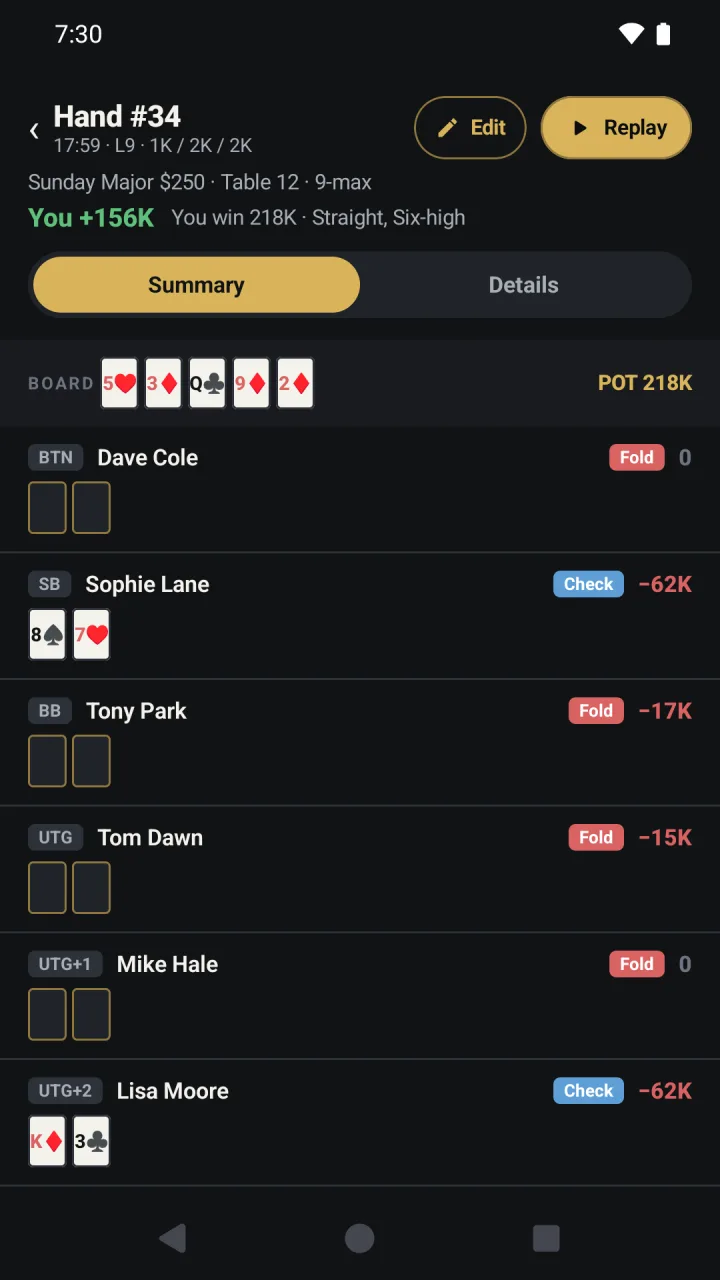
With SSS Poker you record your hands at the table in Table Mode or with Smart Note shorthand, then go back through them in Hand Detail; Pro adds street-by-street replay. Each Game keeps its buy-ins, cash-out or prize, net result and start and end time. It doesn’t add Games up or work out your hourly rate yet; that’s planned. See the live poker tracker for how it fits together.