
Results vs Decisions in Poker: Why a Winning Night Can Lie
You can play badly and book a win, or play well and lose a buy-in. Here's why one session's result says so little, and how to review the decisions instead.
Short answer: in poker, a good decision can lose money and a bad one can win it, so one session’s result tells you very little about how you played. Over a single night, luck is louder than skill. If you want to know whether you played well, look at the decisions you made with what you knew at the time, not at whether the river was kind to you.
Why can a winning session hide bad play?
Picture it. You’re at $1/$3, you call a big river bet with second pair because “he could be bluffing”. He is. You stack him and leave up $600.
Feels like a great night. But if that player bluffs once in ten times there, the call loses money every time you make it. You just happened to catch the one.
Do that a few more times and it becomes a habit. The winning night didn’t teach you anything useful; it taught you something wrong.
And why can a losing session hide good play?
Now flip it. At $2/$5 you get 200 big blinds in with aces against kings preflop. A king hits the flop and you rack up a $1,000 loss.
You made the right play. You’d make it again every single time. The result was bad; the decision wasn’t.
Players who judge themselves by results start fixing things that aren’t broken. They play aces “more carefully”, fold the river when they should call, and get worse while trying to get better.
What does “good decision, bad result” actually look like?
Every hand lands in one of four boxes:
| Good result | Bad result | |
|---|---|---|
| Good decision | Called a pot-odds river bet, he was bluffing. Earned it. | Got it in with AA vs KK, lost. Bad luck. |
| Bad decision | Hero-called with nothing, he was bluffing. Got lucky. | Paid off a nit’s river raise with one pair. Deserved it. |
The two boxes that hurt your game are the diagonal ones. The lucky bad decision feels like a skill, and the unlucky good decision feels like a mistake. The money points you the wrong way in both.
How do you judge a decision without the result?
Ask what you knew at the moment you acted:
- The action and sizes. Pot was $120, he bet $60 on the river. You call $60 to win $180, so you need to be good 1 time in 4 to break even.
- The player. Is he the guy who has shown down two river bluffs tonight, or the one who hasn’t bet the river without the nuts all year?
- The stacks. 40 big blinds and 250 big blinds deep are different games.
- Your hand against his likely hands. Not the one hand he showed, but the range of hands he’d play this way.
Then ask: with all that, was this call (or bet, or fold) better than the alternatives? If yes, it was a good decision, whatever he turned over.
A good trick: when you review a hand, cover the result. Stop at your decision, make the call again in your head, then look at what happened.
How do you review your decisions after a session?
You don’t need a coach or software for this. You need the hands.
- Write down a few hands right away. On the break or in the car, before you forget the sizes. Three to five hands is plenty. Our guide on how to record live poker hands and the hand recording checklist cover what to capture.
- Pick hands by the decision, not the pot. Not just the big wins and losses. Include the river you folded and weren’t sure about, the 3-bet you didn’t make.
- Note what you knew. Positions, stacks, sizes, reads. “UTG regular, 180 deep, opened 15, c-bet small on K-7-2” is more useful than “lost with AK”.
- Look at each decision on its own. Preflop, flop, turn, river. A hand can have a good preflop and a bad turn.
- Write one line per mistake. “Called off river vs nit raise again.” After a month, the same line showing up four times tells you what to work on.
Talk the hands through with a friend who plays. Telling the story without saying how it ended is a good test of whether you’re judging the play or the result.
So should you ignore your results?
No. Over many sessions, results matter. They’re just slow.
A single night, or even a month of live play, can swing a long way either way for a winning or a losing player. Live poker is slow, maybe 25 to 35 hands an hour, so even a busy month isn’t many hands.
Two ways to look at results over time:
- Per hour. What most live players track: total result divided by hours played. Simple, and it’s what pays your bills.
- Per 100 hands. More common online. It tells you how you do per hand, but live you’d need to count hands, which few people do.
Either way, the number needs a lot of sessions before it settles, the same way player stats need enough hands. Keep both views: results over the long run, decisions every session. Our guide on which stats to track for your own game goes further, and the live poker stats guide covers reading the players across from you.
Where SSS Poker fits
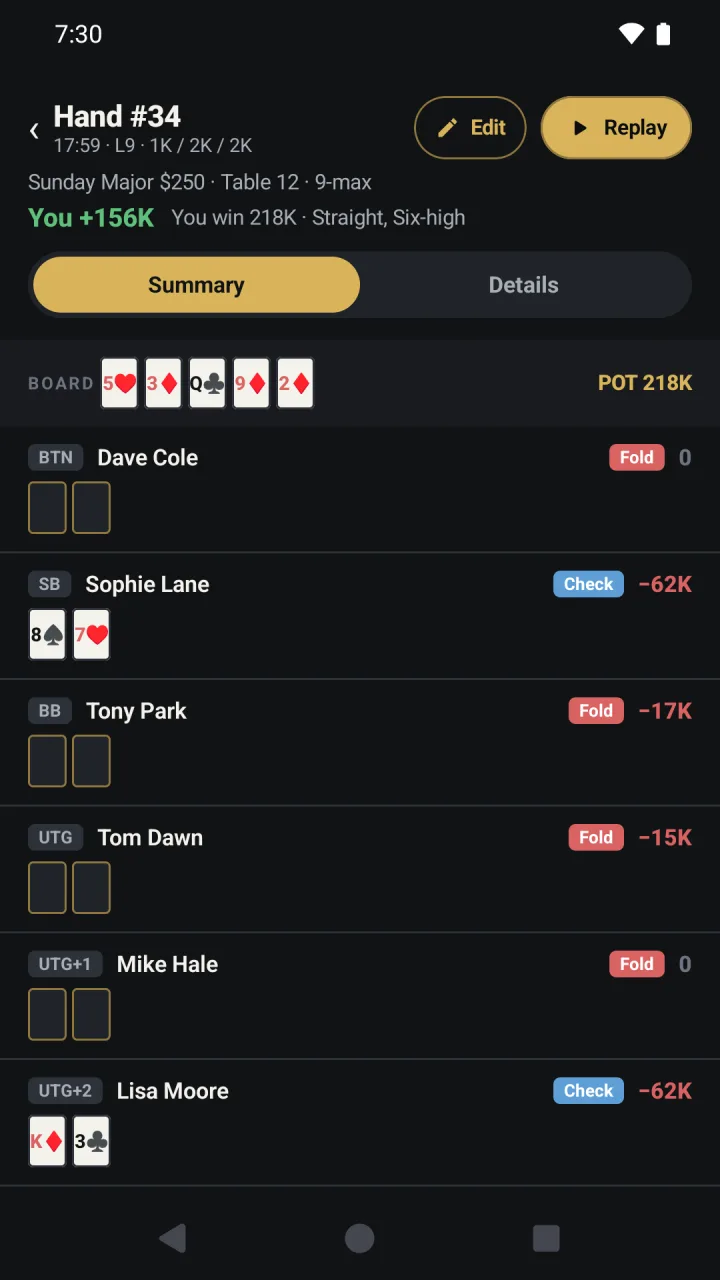
SSS Poker lets you record hands at the table in Table Mode or Smart Note and look at each one later in Hand Detail, and it keeps each Game’s buy-ins and result. It doesn’t add Games up or work out an hourly rate yet (that’s planned), so for totals a spreadsheet still does the job. With Pro you can replay a hand street by street, which makes stopping at each decision easy.