
Hand Recorder App vs Notes App: Which One Should You Use?
Notes is fast and free, a hand recorder makes you write the numbers down. Here's when each one wins.
Short answer: if you review the same night and stick to a strict shorthand, a Notes app is enough. If you want to find, compare or replay hands weeks later, get a hand recorder. Notes takes anything, even a hand with no stacks or sizes; a recorder asks for them and works out the pot as you go.
Full disclosure: we make SSS Poker, which is a hand recorder. We’ve tried to be fair to plain Notes, and we tell you where it’s the better pick.
What are we comparing?
A Notes app is any plain-text app: Apple Notes, Google Keep, a text file. You type the hand however you like, ideally in a consistent shorthand.
A hand recorder stores positions, stacks, cards and every action with its size, and knows the rules. We use SSS Poker as the example because we know it, but most of this applies to any recorder.
How do they stack up?
| Notes app | Hand recorder | |
|---|---|---|
| Setup | None | Install, set up the table and stakes once per Game |
| Jotting a quick fragment | Very fast | Slower, it needs positions and stacks |
| Recording a full hand | Depends on your shorthand discipline | Fast with practice; earlier folds and pot sizes are filled in for you |
| Missing info | Easy to skip stacks, sizes, positions | Positions and actions are required; only legal actions are offered |
| Mistakes | Nothing checks the numbers add up | Pot and stacks are computed, so impossible sizes stand out |
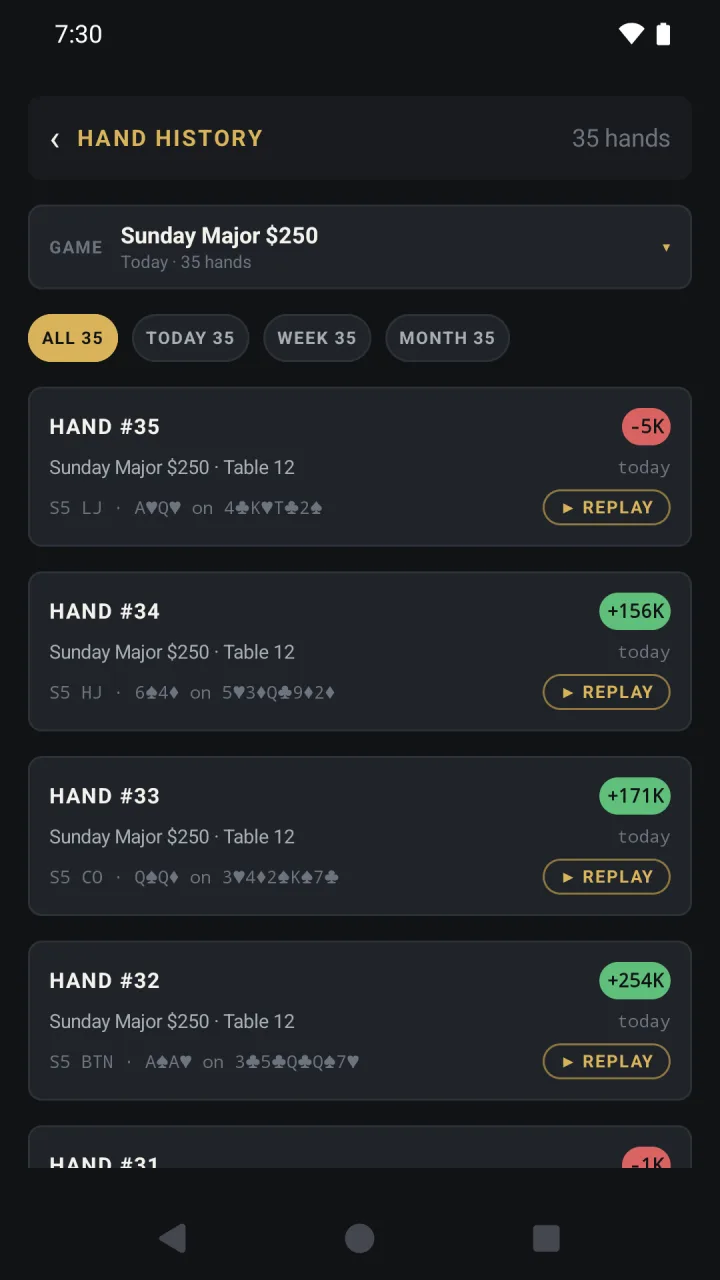
| Finding hands later | Text search, if you used the same words | Filter by time and Game |
| Replay | No | Street by street, in some apps (Pro in SSS Poker) |
| Linking to players | Only if you type the same name every time | Hands are tied to player profiles |
| Export | Copy and paste text | Standard hand-history text files, in some apps (Pro in SSS Poker) |
| Privacy | Depends on your notes app’s sync | Depends on the app; SSS Poker works offline, with no account, and data stays on the device |
| Cost and limits | Free, unlimited | SSS Poker: 30 new hands a day free; unlimited with Pro |
| Loose thoughts | Excellent | Limited to notes fields |
When is Notes the better pick?
Zero friction. It’s already open, with nothing to set up.
Thoughts, not hands. “Table’s straddling every orbit, three guys over 300BB deep” isn’t a hand. It belongs in plain text.
Partial hands. Caught only the river and want to remember what someone showed? A one-line note is perfect; a recorder wants the hand from the start.
Odd games. A variant or home-game rule a recorder doesn’t support? Plain text copes.
No limits. Notes never asks you to upgrade.
Jot three hands a night and talk them through with a friend the next morning? A disciplined Notes habit is a perfectly good system.
When does a recorder pay off?
Mostly after the session, not at the table.
You see what’s missing. BB 3b, I called, flop Kx, he bet, I folded feels complete when you type it. A week later, with no stacks or sizes, there’s nothing to review. A recorder won’t move to the flop until preflop is settled, and shows the pot at every step.
Hands line up. Same fields every time, so you can pull up every hand from one Game or against one player. With plain text you’re hoping you used the same words.
Player history builds itself. A hand against your Friday-night reg adds to their history automatically. In Notes, you have to copy it over yourself.
You can watch it back. Stepping through street by street with the pot and stacks moving beats re-reading a line of text, especially multiway.
Either way, the hand recording checklist covers what to write down.
How we’ll test this
We haven’t run a timed test yet, so there are no speed or completeness numbers here. When we do, this is the plan, published with the results:
- Hands: three real live hands written up first as a reference: a simple heads-up hand, a 3-bet pot, a multiway pot to the river.
- Recording: each hand twice, in a phone Notes app with our cheat sheet shorthand and in SSS Poker on Android (Table Mode and Smart Note), alternating which goes first.
- Timing: from the end of the hand to the last character or tap, measured on screen recordings.
- Next day: a second person rebuilds each hand from the record alone and lists what’s missing or unclear: positions, effective stacks, each action and size, board, showdown.
- Replay: whether the hand can be stepped through street by street with the right pot.
- Limits: one experienced tester, a handful of hands, one device. The results describe that setup, not every player.
Doing it in SSS Poker
SSS Poker gives you two ways in: Table Mode, where you tap actions seat by seat with only legal actions offered, and Smart Note, where you type shorthand like co raise 5k and earlier seats that didn’t act are filled in. Hands land in your hand history, filterable by time and Game. Free covers 30 new hands a day; Pro adds unlimited hands, Replay and hand-history export.
See the hand recorder or how to record live poker hands.